
What's New? - Televisions Mutual Contract
Chris Fite-Wassilak on the work of Michelle Deignan, 2009.
Montage of various impersonal street scenes. The disembodied voice of a young-sounding woman with a flat English accent says: "Eight years on from the war, poverty is rife in Kosovo and it effects all the ethnic groups: Serbs, ethnic Albanians, and Roma people. Many young ethnic Albanians say independence or not, they want to leave Kosovo."
A man in his early twenties appears, a microphone held before him. He begins to speak, what sounds like French, before he too is cut off, talked over. It is another male voice, younger than the first, with an indistinguishable non-native English-speaking accent, speaking with a deliberate colloquial slur on his pronunciation.
"I hope it'll be better if we get independence, but I'm goin' to leave whatever happens. Young people just can't find work. When they go to a café, can't even afford to buy a coffee. They don't even have a Euro in their pockets." [1]
Such a sequence is not unusual in factual broadcast. Capitalising on the medium's personal reception, the ease of accessing video news reports from the TV set or the computer desktop, the narrator addresses us directly and authoritatively, guiding us through facts with the imagery that authenticates them. For that time, the presenter is the logos of this miniature universe. We almost don't notice the accents, such an accepted mode of delivery it has become. Take, for example, the female presenter mentioned above speaking with 'Received Pronunciation' English, sometimes referred to as 'BBC English.' The BBC itself claims it never imposed pronunciation on its presenters, calling BBC English a 'myth,' [2] though it remains an accent used to convey a tone of education and authority [3], used widely for most English-speaking news programs outside of America, including Al-Jazeera. A method adopted more prominently in the past few years involves, as above, attempting to dub translations with voice actors whose accents approximate or mimic the person being translated, as if the person being quoted were translating and providing the voice over themselves. [4]
Within this system of direct delivery, we often forget about these voices and personalities as mere siphons and vessels. But occasionally we might step back and ask: who is the presenter? And why are they talking to me like that? And who the hell are the accomplices, with chameleon-like accents ready to interrupt anyone and everyone? These are the protagonists and actors of Michelle Deignan's video works. Deignan's practice takes on the language of television, the delivery of the 9 o'clock news magazine 'special report,' turning it into a sprawling form of personal essay. At the centre of this web is the not-so-innocent presenter.
According to the UK government Careers Advice Service, for the career of TV presenter, "your main purpose would be to engage with the unseen audience. The right look, personality, and skills are more important than qualifications...drama school or acting lessons can be useful for learning presenting skills." [5]. The presenters of Deignan's videos have the familiar, polished quality we know almost innately, a formal distance combined with a knowledgeable confidence. They talk to the camera, making hand gestures to punctuate their statements, and lilt their voices at all the right points. The stories that are uncovered in Deignan's reports, however, are meandering tangles of private encounters and public discourse.
Il Cittadino (2007) is ostensibly a short, informative 'human interest' piece about the quiet northern Italian town of Sequals. The female presenter, who looks and sounds like a native Italian, begins by giving us a short summary of the town, its facts and points of interest: geography, population, its Slavic influences. When she introduces us to the town opera house, though, we are informed, "Michelle Deignan, the author of this film, went to see a play here." Suddenly, we are given a third-person account of Deignan's falling asleep, and possibly snoring, during the performance. Her narrator walks a fine line of presenting subjective experience with the news presenter's air of factuality. The remainder of the film extends from there to include facts and events that tangentially tie in with Deignan's own personal thoughts and actions from her time in Sequals, from the international Irish pub industry, to Richard Hamilton's feces, and the illegal activities of the CIA in Italy.
Similarly, Red Cheeks (2006) presents itself as a tour of Irish institutions found in London: the RTE office at Millbank, the site of Irish Contemporary Art, and the London Irish Women's Centre. The presenter herself is Irish, speaking with the tempered south Dublin accent commonly found on RTE's airwaves. Disrupting this structure, however, are a series of anecdotes about Deignan; we hear of her complicity in an educational documentary about the Sufragettes, agreeing to be chained to a railing to demonstrate some of her methods, in exchange for "some pints of beer."
After informing us of the Women's Centre's capacity to deal with hate crime, the presenter recounts an incident where Deignan confronted an elderly woman making racist comments. Looking evenly at the camera, she says, "In a voice that shook with shock and anger, Michelle said, 'You are a fucking bitch.'" Here, the contrast of the straight-faced delivery and strong language highlights the eruption of the personal into the rigid codifications of television. The institutional structure of each video is infected with an impossible subjectivity, becoming a hybrid of formal distance and frank honesty; the actual subject matter of these works posing as documentaries becomes a shifting site of conflations, relationships and associations.
Deignan's editing technique further accentuates the presenter's peculiar role as mediator of this ambiguous territory. In Il Cittadino , Red Cheeks and Our Land (2008), angled jump cuts provide us side and back views of each presenter as they speak. In Il Cittadino , just after she has begun relating Deignan's opera vignette, we are given a shot-reverse-shot over her shoulder: she is speaking, gesturing as she has been, to no one. Suddenly, the agency and motives of the presenter are thrown in sharp light. The revelation of that simple sequence playfully tosses up the suggestion that they are not speaking to us in particular, but simply speaking out loud. The figure of the presenter transforms from the reliable, assured carrier of fact, to a wandering flâneur, a pedestrian collector of information and curiosities who inexplicably, obsessively recounts the things that they have learned. They share the autistic individual's "incapability of dishonesty,"[6] listing off details about the place they are, blurting out their employer's personal history, disclosing the occurrences and coincidences that make up the background of the work.
In Edward Branigan's book Narrative Comprehension and Film, published by Routledge in 1992, he depicts a diagram detailing eight levels of narration. Starting at the top with a film or text's factual, historical author, it details down to, on the lowest level, the inward thoughts of a character. (See Figure 1 below.)
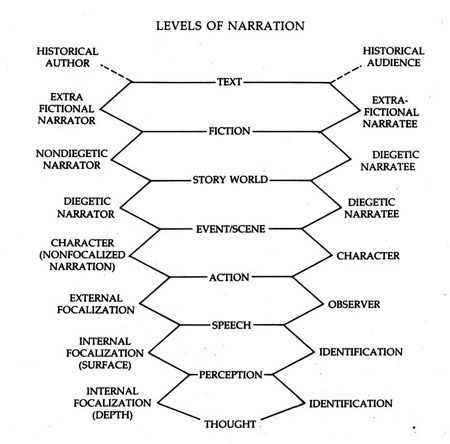
Figure 4: Branigan's Eight levels of narration, Narrative Comprehension and Film (London, Routledge, 1992), page 87.
Classic television and documentary presenters naturally pose as 'extra fictional narrators.' This is the narrator who presents themselves as above the world of the story; in fiction, this type of narrator presents himself or herself as the author; in documentary forms, this is the person reading the scripted information, commenting on a scene without ostensibly being involved with it in any way.
Within factual broadcast, however, they are part of the fiction: within the fabric of the film itself. Television and documentary presenters actually take part as 'nondiegetic narrators'[7] in the form of the voice-over, and 'diegetic narrators' when they physically appear before the camera on location. Deignan's narrators often discuss "this film," openly acknowledging their presence interwoven within the work and discarding the pretense of being above the fiction. But as presenters overseeing the rhizomatic alignment of events in Deignan's videos, they are also slightly more unhinged, ambiguously becoming historical co-authors as well as characters within the world of the work.
Set in St. Anne's park in north Dublin, Our Land deals with the park's history as the former property of the Guinness family, as well as with the Red Stable artist studios recently established within the grounds. In addition, it presents us with a vast array of tangential information; tidbits that are suggested as implicitly relevant but their significance remain unexplained. More than any of her other works, Our Land stretches the apparent subject matter of its documentary form to just short of breaking point. A description of the Irish soldiers' mutiny in Solan, India in 1920, an account of the Irish language's grammatical lack of the affirmative or negative particles 'yes' and 'no,' and a brief introduction to the Enlightenment-era gentleman's club the 'Lunar Society' all sit quietly at odds between close-up shots of the park's vegetation and our two narrators' guide to its mammalian population (both human and non-human).
Through the gaps of this disparate information, the presenters begin to assert themselves as active protagonists within the fiction. Several of Our Land 's anecdotes point directly back to the presenters; in one, the female narrator tells us of Deignan's encounter with two voice coaches in a restaurant, who she then "asked if they knew of any actors, of Asian ethnicity, that could do a Birmingham accent." Is it not explained whether this encounter led on to the hiring of the two actors we find before us, who seem to fit this description.
Similar to the concluding anecdote of Red Cheeks , Deignan uses the 3rd person description of personal events to expose the video's hierarchy of narration, but here it is overtly the presenters who become the work's subject matter. Facing the screen, the male narrator, in full 'Brummie accent' mode, describes an occasion where a Dublin man brings his 'British Asian' friend to a Gaelic football match in Dublin's Croke Park. The story ends with a group of Dublin youths passing the two friends singing, 'I'd rather be a Paki than a royal." "That was fucking great," one of the kids says, "We were singing about Pakis, then one arrived." Throughout the telling of the poignant tale, the presenter keeps a straight face, though its level of detail seems to reveal that the man he is speaking about is himself.
At the closing of the video, both actors convene at one of the stable windows, and leave the script, and the tone of objectivity, behind. The third person is abandoned, as they argue about the semantics of words used to describe the scene of the park before them. "Nature is great and I'm astonished by it. I might even be afraid of it," the male presenter states. "You're not afraid of it," the woman counters. "I think you'd like to be. Makes it more exciting." Throughout the video, they spoke in alternate scenes, and occasionally side by side, never acknowledging the other's existence. But now, no longer are they speaking to us, to the camera, or even to no one, but are bickering with each other. Shedding the role of 'presenter', they step in to take part, openly and subjectively, debating and commenting on the 'subject' of Our Land , the park. As if they had both been itching and seething to comment the whole time, the man's yearning idealism clashes with the woman's acerbic pragmatism, but also emphasizes the standpoint implicit the supposedly objective language both had used earlier in the work. Having cast it off, the two narrators expose the 'presenter' as an emotionless shell, an archetypal character that is temporarily inhabited, cloaked in an air of objectivity and authority.
Similar to the constellation of information presented in Our Land , Unmaking or Redoing (2006-07) exposes the roots of its own narrated production, with Deignan herself providing a first-person voice over. The video centres around one evening where Deignan was photographed by the police, mistaken as someone exiting the London Action Resource Centre in East London; the police had been staking out this venue as the site of a suspected clandestine meeting. The video itself, though, provides only a verbal description of the event, as well as footage of rehearsals for a walking tour inspired by that night, before spiraling out to become a meditation on police surveillance in London, as well as a 'making of' documentary for a photographic artwork exhibited on the streets of Vienna. Like a politicized take on Rob Reiner's documentation of a nonexistent band in Spinal Tap (1984), Unmaking or Redoing circles around and shoots out from a central event which is not present. [8] What remains is a series of traces, reconstructions, and remembered accounts that have hesitantly huddled together to form this twelve-minute video essay. As a parting shot, it takes on the tone of a Public Service Announcement, informing us, "If you want to get a copy of a photograph of you taken by the British police, get a Data Protection Act Form, and with this apply directly to the keepers of the Police National Computers Database. There is normally a ten pound charge for this service."
The shift in Unmaking or Redoing from Deignan's first person voice-over, to the voice of the actor John Hurley is characteristic of Deignan's method of disclosure. We see Hurley casually beginning to practice his role as the guide of the abandoned walking tour, stumbling on his words and appearing quite relaxed. But as we shift to Deignan's footage of the police presence at May Day celebrations in Trafalgar Square, he disappears from in front of the camera, to take over as the formal tone of the video's voice-over narrator.
Deignan reveals the placement of experience that takes place in television footage, through camera and editing techniques that frame the narrative's delivery via the presenter. Opening up spaces between each of these elements, her videos initially create the impression of a wayward news magazine program, where the relationship of the camera, narrator, and the subject is happenstance, a strange coincidence. But it discloses the fiction, revealing the liminal fabric through which television and documentary forms present their information, examining its particular culture and form of address that has come to such dominance in our times. Deignan openly provides us with all the elements that go in to the making of her works, its circumstances and motivations, intimate, social and political. She acknowledges what has been invested in each work, and through this demands what we as viewers invest in the creation and belief of what we are watching. What's exposed is the mutual contract and after that, watching news just isn't the same.
References:
Bad News (The Comic Strip Presents, 1983)
The BBC's 'From Our Own Correspondent
'Brass Eye/The Day Today
Alfred Corn's weblog, accent entry: http://alfredcornsweblog.blogspot.com/2008/09/accents.html
John Ellis, Visible Fictions (London: Routledge, 1992)
'Foreign accent syndrome' Mark Haddon, The Curious Incident of the Dog in the Night Time (Doubleday, 2003)
Chris Marker, Letter From Siberia (1957)
www.Voice123.com
[1]Russia Today, "The first 24/7 English-language news channel bring the Russian view on global news." a broadcast of 16 October,2007, www.russiatoday.com
[2]G.M. Miller, quoted in "Received Pronunciation and BBC English" by Dr. Catherine Sangster, http://www.bbc.co.uk/voices/yourvoice/rpandbbc.shtml
[3]A Google search for 'BBC accent translation' produced as its first result a link to voice actor Glen McCready, whose "voice is versatile - from energetic, dynamic hard sell to velvet, chocolate tones for commercials. He is a classically trained actor and smooth, rich, Standard English Pronunciation (R.P./BBC English) is a speciality - ideal for corporate narrations." ( http://voice123.com/glenmccready)
[4]Although slightly different in its implications, this additional clip from Russia Today is worth watching, if only for the voice-over of Gaddafi's 'Welcome to my Bedouin tent": http://www.youtube.com/watch?v=Y4visjQKAvk&feature=channel
[5]http://careersadvice.direct.gov.uk/helpwithyourcareer/jobprofiles/profiles/profile829/
[6]Professor of Developmental Psychopathology Simon Baron-Cohen, "I Cannot Tell a Lie," http://www.incharacter.org/article.php?article=101
[7]'Diegesis' denotes the fictional world of the narrative, a term first used by Gerard Genette, in Narrative Discourse, translated by Jane E. Lewin, Oxford, Basil Blackwell, 1980, footnote page 27.
[8]Take, also, for example Kurt Vonnegut's 1969 novel Slaughterhouse 5 , which takes as its inspiration and central subject matter the bombing of Dresden by the Allies in February 1945. The bombing itself is not actually directly witnessed or described, instead dealt with through pre- and pro-ceeding events.
© 2009 Chris Fite-Wassilak
Chris Fite-Wassilak is a writer, freelance critic and curator. He is the co-founder of Dublin-based collaborative comic 'This Way Up', and a regular contributor to 'Frieze', 'Circa', 'Contemporary Irish Art', and Artforum.com. His curatorial projects include 'Lighthouse', a caravan cinema parked in the Truman Brewery co-curated with David Beattie in June 2007 as part of the wider House Projects set of exhibitions and Corpus Callosum at Studio 1.1, London in January, 2009. Chris is the recipient of the 2008 Hayward Touring Exhibitions Award, conceiving and curating a group exhibition called 'Quiet Revolution' which will begin in Milton Keynes Gallery in July 2009 www.growgnome.com
----------------------------------------------------------------------------------------------------
'The Irish Times' Visual Arts Review, 11 April, 2007.
How the personal becomes wrapped up in the political
Aidan Dunne
Michelle Deignan's After the Fact at the LAB is a fascinating exhibition. Mind you, you have to put in the time: it comprises five substantial video works, all quite involved, all requiring sustained attention. Lest that sound too forbidding, the good news is that they are also funny and entertaining, and they work on several levels, prompting us to reflect on what we are looking at, not only in the gallery but all the time, on mainstream television.
Her work addresses two areas particularly pertinent to the contemporary world: the representation and mediation of experience; and surveillance. There is a strongly autobiographical flavour to most of what she does. Actors playing the role of television presenters or reporters give anecdotal accounts to camera of episodes in her life. Workaday events are recounted with the gravitas of news programmes. It is engaging, and amusing in itself and in incidental detail - witness the account of her encounter with an elderly, racist customer in a pharmacy. And after a while you think: well, why not? There is a certain absurdity to the relentless dissemination of information by rolling news channels, and Deignan's videos catch that perfectly.
It becomes apparent that the day-to-day life of this one individual, a kind of Everywoman, intersects and is implicated in a web of cultural and political issues, and that the same necessarily holds true for everyone else as well. In one piece, for example, we hear of her experience working on the decoration of an Irish-themed pub in Italy. In a skilful piece of narrative, delivered by a third-person reporter, after the fact, we get a sense of her feelings of cultural displacement, and learn that the adjacent military airbase is being used as a staging post for rendition flights that may be illegal. In a world characterised by globalisation and rampant commodification, Deignan implies, the personal is inevitably wrapped up in the political, and to underline the point she tries to get to the much-filmed location for television news reports, outside 10 Downing St, in To Camera.
In Unmaking or Redoing she recounts how she and a companion came to be photographed by a police surveillance unit when wandering down a street in East London. Instead of merely walking away, she opted to ask why. Because they had emerged from a suspect premises, she is told. In fact, and rather worryingly, they had not emerged from the building in question, but simply stopped to look in the window out of idle curiosity. A mistake then, and she is told that the information will be erased. To get hold of the surveillance photo, though, she will have to apply to her local police station.
Which she does, vainly.
Her treatment of this material in Unmaking or Redoing does not, in fact, amount to anything like her best piece, perhaps because we see too much of her hesitant progress through the location with an actor she is priming to play the role of narrator. The whole thing becomes a bit too meandering. A degree of meandering is actually integral to her approach, and generally works very well, and to be fair Unmaking, despite its relative weakness, is intriguing in its layering of the process of representation. A similar effect is obtained in Assumed Position in which, showing exemplary nerve, she plays the role of an artist taking a series of impromptu street portraits of passersby on a pedestrian link in London's financial district.
The latter is largely, and successfully, a video of an extended feat of performance, with a voice-over commentary. Unmaking suffers, perhaps, because it is one strand too many in a slightly overcrowded show. The effect of any individual piece is exceptional. Given the level of overlap, five together in one space tends to dilute the impact. It's hardly incidental that the work is achieved with tremendous competence, technically, and in terms of its dramatic elements, both writing and performance. It really is a user-friendly show.
© 2007 The Irish Times
----------------------------------------------------------------------------------------------------
This Space is Unstable
Alison Green on the work of Michelle Deignan, 2002.
Coming in from Heathrow, just about at the point when you know you're really in London (when the few miles of suburbs turn into the recognizable density of terraced houses) there is a surprising sight: a full storey-height TV screen, in a curved corner window on the ground floor, running news and stock quotes, I think there courtesy of Bloomberg. Maybe a talking head is pictured; mouthing words you cannot hear, and numbers flow horizontally or vertically, FTSE, DAX, NYSE, HANG SENG, etc. Doubly-distanced, framed by the windscreen of the car and the window of the building, it’s just another image fleeting; before it on the left, the minaret of a mosque, next, Tesco Central.
Now, London is not apparently a city driven by media and technology, not like Tokyo or New York. This corner-screen in Baron’s Court is not the Big Brother one in Times Square. "London" is meandering streets, white stuccoed facades and gardens. But this is why the screen stands out, incongruous with the streetscape. Maybe it is meant to be there, though, since the UK loves the media. This is true, and it makes for a kind of schizophrenia between the old and the new, which sometimes divides the classes, but more often feeds a compulsion to catch up with the modernity that exists elsewhere. People in Britain watch a lot of TV. And, the TV industry, although smaller than LA’s, draws more than its fair share of creative talent and is the engine behind contemporary culture.
The work of London-based artist Michelle Deignan is about this close correspondence between the media and an individual’s experience of culture. This is not a particularly new subject for art: pop artists figured it overtly perhaps the earliest, and Warhol closed the gap between an "art world" and the other world, claiming a certain kind of status that was generated by the media. Skip forwards 40 years and TV now has depth, variety and a history. Deignan’s work is about TV’s texture, its locations, its duration, and pacing. Some of her works explore the way certain television shows are made; others do the same for camera, editing and graphics technologies. But she attends to the background, so that within these investigations of what is new, she adds what is commonplace, and shifts the subject of a work from figure to ground, so to speak. She shows you what you never see: TV’s structure and what never makes it past the editing room.
Modern art has made much of its relationship to popular culture. Whether it distinguishes itself from it or considers itself part of it, it needs the idea of a mass or popular culture for its self-identity. The various meanings and historical moments of this relationship do not need to be elaborated here;[1] it should suffice to remark that it is unresolved, and perhaps irresolvable. Current claims that contemporary art has collapsed into culture at large seem simplistic, self-serving, or at the very least premature. Artists court the wider audiences and better remuneration of the film and TV worlds, and the popular arts return the compliment by borrowing from artists. Video art, especially, facilitates this cross-flow because the medium allows it. (In the 80s this took the form of sampling; now artists tend to generate their own content.) The drive behind both popular and fine art is technology, although in both cases technological novelty fares badly when looked at retrospectively. As many have noted, the crucial originary moment for video art was the availability in the late 60s of professional-quality video cameras that artists could afford. Because video was also cheap to make (compared to film—no processing) and the camera didn’t require training or expertise, it was a perfect medium for "experimenting". More than that: as a medium it is instantaneous. Since then, a history, a political stance, and a set of rules for making and exhibiting has developed around video art; but it remains in close relation to (a subset of, threatening to dominate?) contemporary art in general. Along the way, video art also grew up, learning the politics of representation and the powerful seduction of high production values. Very recent events in the history of technology have had a huge impact on anyone working in video now; in the last 5 years, digital cameras, and subsequently digital editing software have become available to non-professionals. Artists can fairly easily produce technically sophisticated work, with a relatively small amount of money and training. What makes video a compelling medium for artists today—whether exclusively or sporadically—is how direct and tangible it is, and how it still seems to shrug off the consolidating formalities of older genres.
A good place to start a discussion of Deignan’s work is with one of the pioneers of video art: Bruce Nauman is an éminence grise for British art of the 90s, not only on account of his video works but more generally as an artist who inaugurated a different kind of object, that at first appeared thin or wanting. The conservative critic Hilton Kramer remarked in 1973 that a show of Nauman’s work amounted to "a few sculptures of no sculptural interest, a few photographs of no photographic interest, a few video screens offering images that somehow manage to be both boring and repugnant".[2] Instead of formal intensity, Nauman’s work seemingly depicted nothing—sometimes it would be the viewer herself walking through one of his corridors, other times it would be Nauman in his studio making repetitive or nonsensical gestures. Now we see these works as reflections of sculptural experiences, where the viewer or the artist takes the place of the work of art.[3] Works of Deignan’s, like "Modern" and "Daylit" are similarly slight, similarly content-less, and, similar to Nauman’s early videos, use the medium to place the viewer inside a structured perceptual experience. Importantly, this space is unstable.[4] "Modern” forges a link between a device that makes the camera pan in a 360º circle with the escalators that run up the centre of the Tate Modern. The collision of the two moving machines forms a certain experience of space not possible with either one alone. Mildly disorienting, the piece emphasises the vertical rise, horizontal circulation across each floor, and descent in reverse through the building. It seems to analyse the building’s structure and the way one is directed through it, made all the more complex, and closer to real, by a device that is not fixed in a single direction. A few times the two movements coincide (the camera facing up and the escalator going up), creating a moment of hypostasis, a short breather before the movement starts again. Similar to Nauman, Deignan lets an exterior logic determine the form of the piece (in Nauman’s case, the duration of his videos often were the length of the tape; in “Modern” it is the completion of the escalator tour). Deignan used the same panning device on the camera for “Daylit”, which was filmed in four bedroom spaces, and which obtains its similar complexity from the way she laid it out graphically, as flat, juxtaposed, moving images. The piece is a process of flattening: taking a necessarily deep image (the volume of the room being one of the simplest 3D forms) slipping across a horizontal axis, reduced to a visually engaging, almost decorative, almost abstract image. Both these pieces seem like exercises in identifying video’s current technical capacity. And it should also be remarked that Deignan’s approach is far from the grand designs Krauss ascribed to Nauman et. al., of “dispensing with an entire critical tradition.”
Recent works suggest that Deignan is not interested in the “medium” in a general sense, but more specifically how it is used professionally. In other words, her work is not really a repetition of questions about video’s inherent qualities and how it could be used as sculpture, but directed instead at television’s visual language and how it can be mined for video art. Works like “One Hundred Percent”, “15:1” and “Titles” are based on specific TV programmes. Each follows a different process of abstraction, by way of distillation: the “content” is stripped out and the “structure” laid bare. In this way Deignan uses standard modernist strategies of simplifying in order to focus attention on commonalities (the grids in “Titles” replace the animated text, videos and images in a show’s title sequence; thus you see graphically instead of reading text and images). But, importantly, her abstractions are made from things that are already very abstract. She is working with “cultural” objects rather than “natural” ones, and as such they are already highly constructed. “One Hundred Percent” and “15:1” repeat the series of camera shots used in these two shows. Deignan chose them because of how formulaic they are; it is the set (rather than a narrative) that determines the structure. (She has said that the shots are exactly the same form one episode to another, so her “deconstruction” stands for any one of them.) There is a point to this, and I suggest it is that such things have become like nature to us (a minaret, a TV screen, a supermarket, and maybe a tree in there: all the same). Paradoxically, Deignan wishes to add depth (recall the facture) to a medium slipping easily into its surface. She reminds us—via abject simplicity—of the complexity of the medium we watch all the time. And at the same time, shows us how simplistic a lot of it is.
These three works function as both homages to the television shows they are based on and negations of the complete picture television normally offers. As negations, they follow avant-garde strategies that resist the medium being “artified”, or made aesthetic; this resistance to “the whole” is proof of the work’s artistic integrity. Categorically different from the kind of video art that either shoots already occurring events, or stages original content, Deignan’s work is a type of pseudo-mimesis that critiques—perhaps only implicitly—other art that seems to collude with the aesthetic values already established for TV. In this sense it is parasitic, which is characteristic of neo-conceptual work. (The first time round conceptual artists mainly used photography to critique established genres of photography; it seems obvious that of urgent interest now would be television.) Deignan’s choice of subject matter (“One Hundred Percent” and “15:1” are quiz shows) suggests the lowest of lowbrow culture, but at the same time you have the sneaking suspicion that it is not merely the ideology of anaesthetics that motivates her. On the contrary, such specificity suggests that her subjects are embedded in her own history and experience. Perhaps it is the guilty pleasure associated with watching daytime television, or the direct identification viewers have with quiz show contestants (“I can answer that!”).
The quiz show illustrates what my favourite thinker on television—George Trow—describes as one of its central formulations: that TV simultaneously has two grids, the grid of intimacy and the grid of two hundred million.[5] This is a very strange condition, to be poised between yourself and a “community” with whom you have no other connection than the medium that created it. Trow’s description of TV’s split personality is surprisingly similar to Krauss’ famous claim that psychology constitutes the medium of video.[6] For Krauss, screen images draw attention away from physical surroundings (monitor, room, projection equipment) so that one’s experience is primarily intense identification between the self and the projected image. Krauss was describing what we now take for granted—that there is no consistent self, only a series of representations, most of which come from the culture that surrounds us. Trow is more specific: TV is our history and our collective personality. He calls TV the third parent, and that figure is not parental, but “a value-free ritual.” I suspect that like Trow, Deignan’s interest is not the history of art and its media, but in how to gain any kind of critical purchase on contemporary culture. It also seems important that she makes her living in video production. Previous generations of artists could not have been so close to mass culture without seeming to jeopardise their credibility, but in some way that’s difficult to articulate, the opposite is now true.
Deignan’s approach seems situated between film and video’s structuralist past and art’s populist, neo-romantic present. She maintains the notion of critique in the former, but also uses video for all it does well, and that is its evocative ability to capture and re-present the world as it goes by like a stream of consciousness. Like a lot of art now, Deignan’s work ultimately aspires to film, its popular appeal and effectiveness as an absorptive medium. Barry Schwabsky has recently observed that “artists may be interested in cinema precisely to the extent that they experience it as not structurally connected or homologous to art. This is what allows it to function as ‘material’ to be worked on.”[7] This is in a discussion of Douglas Gordon, but I think it works better for Deignan (her work should be described as the opposite of his—“24 Hour Psycho”, for example, is replete with the original, while “One Hundred Percent” and “15:1” work literally with the original’s absence). Her works are like proxies for lost experiences, where the original ones never kept their promises. She tracks, in some cases to the place where the TV show was made, sniffing around for traces that might hold its unfulfilled potential. Ironically, Deignan’s works are full even though they first appear empty.
•••
[1] A good essay that tackles the complexity of this subject is Bettina Funcke, “The Masses Laugh Back: Exposing the Artist’s Persona on TV,” in exh. cat. The Glass Eye: Artists and Television (Project Press). Deignan was included in this show. [return to text]
[2] Hilton Kramer, as quoted in Neal Benezra, “Surveying Nauman,” exh. cat. Bruce Nauman (Walker Art Center, 1994), p. 30. [return to text]
[3] Rosalind Krauss makes this point in an important early essay, “Video: The Aesthetics of Narcissism,” October 1 (Spring 1976). She situated early American video art in the discourse of art generally: artists like Nauman, Vito Acconci, Lynda Benglis, Richard Serra, Peter Campus and Joan Jonas “were largely involved in parodying the critical terms of abstraction”, and this was “clearly intended to disrupt and dispense with an entire critical tradition.” p. 52. [return to text]
[4] This is what made early video art fit existing discussions of the avant-garde. See, for example, Chrissie Iles, “Between the Still and Moving Image,” in exh. cat. Into the Light: The Projected Image in American Art 1964-1977 (Whitney Museum of American Art/Abrams, 2001). [return to text]
[5] George W.S. Trow, In the Context of No Context (Atlantic Monthly Press, 1997). [return to text]
[6] Krauss, “Aesthetics of Narcissism,” p. 52. The idea has to do with the way, unlike other media, even photography, video has the potential for instant feedback. She relates this to the media’s effect on art production such that it renders invisible anything that does not get reported. [return to text]
[7]Barry Schwabsky, “Art, Film, Video: Separation or Synthesis?” in Nina Danino and Michael Mazière, eds., The Undercut Reader (Wallflower Press, 2003), p. 2. [return to text]
Alison Green is a London-based critic, curator and art historian. She was the director of the Stark Gallery in New York from 1990-96; more recently she worked as an exhibition organizer at the Barbican Art Gallery. Publications include: “A Short Chronology of Curatorial Incidents,” in Gavin Wade, ed. Curating in the 20th Century (University of Wolverhampton, 2000) and the forthcoming “‘When Attitudes Become Form’ and the Contest over Conceptual Art’s History,” in Michael Corris, ed. Conceptual Art (Cambridge University Press, 2004). She is currently working on a PhD on the American painter Myron Stout, and writes regularly on contemporary art for Art Monthly magazine.